
 Lubbock, TX
 Mon–Sat · 8:00 AM–6:00 PM
Appliance Repair in Lubbock, TX
Prairie Crest Appliance Repair helps Lubbock homeowners narrow down refrigerator, washer, dryer, dishwasher, oven and other household appliance problems before repair decisions are made.
Start with the appliance and the symptom: what stopped working, when it started, and whether there is an error code, leak, unusual sound, smell or temperature problem. We cover 13 household appliance categories, each with its own service page and diagnostic guidance.
 Call (806) 207-2100

 13 appliance categories
 Symptom-first diagnosis
 Lubbock + nearby communities
 Safety-first guidance
 Best first details: appliance, symptom, brand/model and any error code
 Gas smell, arcing, smoke or water near electrical parts: stop using the appliance firstPrimary nearby areas include Wolfforth, Shallowater, Slaton, Idalou and Levelland
 Prairie Crest Appliance Repair · (806) 207-2100 · support@applianceinlubbock.com
Your starting point for appliance repair in Lubbock
Choose the appliance, identify the symptom, review diagnostic and safety guidance, then open the dedicated service or guide page for deeper detail.
Find your appliance problem
Start with what you are noticing. This selector is a starting point, not a diagnosis—two appliances can share the same symptom for completely different reasons.
 Laundry is soaking wet, the washer will not start, drain or spinWashing machineWasher repair Clothes take multiple cycles to dry or come out coldDryerDryer repair Dishes stay dirty, cloudy or sitting in standing waterDishwasherDishwasher repair The oven will not heat or heats unevenlyOvenOven repair A freestanding range burner or stovetop will not ignite or heatStove / CooktopCooking repair No ice, slow ice production or leaking around the ice makerIce makerIce maker repair The microwave will not heat, sparks or the door will not latchConvection microwaveMicrowave repair The vent hood is not pulling air, the light flickers or the fan is noisyRange hoodRange hood repair A built-in trash compactor jams, will not start or the ram will not moveTrash compactorCompactor repair Slow refrigerator water/ice flow, bad taste or a leaking filter housingAppliance water filterWater filter repair
Appliance repair services in Lubbock
Each service page covers symptom-specific detail, common possible causes, safety considerations and what a diagnostic visit typically involves.
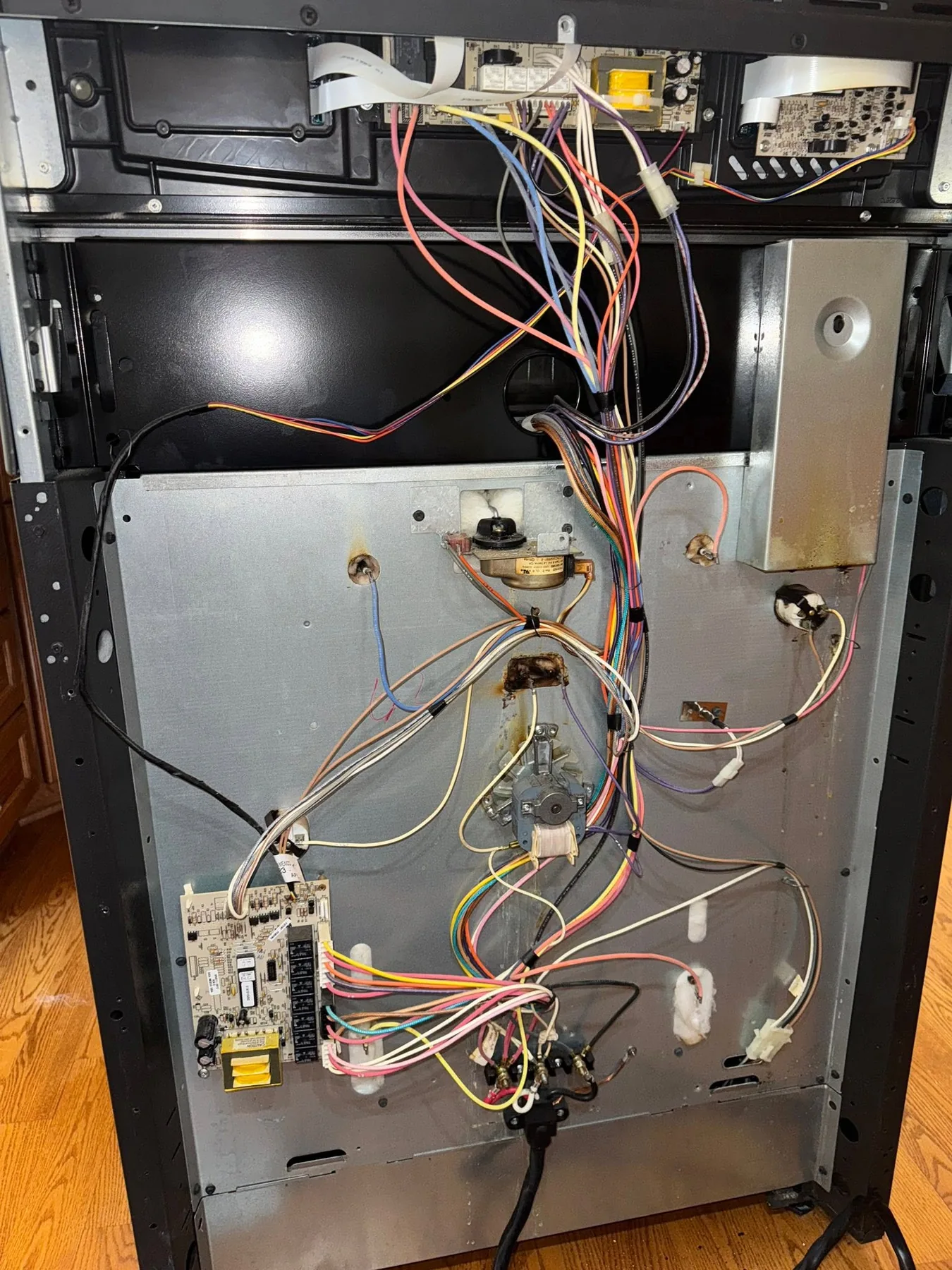
Cooking appliance diagnostics involve more than the display
Ovens, stoves and cooktops have heating, control and electrical components that may need professional testing. The exact checks depend on the model and symptom.
Explore oven repairPhoto: rear panel and wiring of a cooking appliance.

Refrigerator Repair
Not cooling, uneven temperatures, unusual noise, water leaks, ice buildup and dispenser issues.

Freezer Repair
Standalone upright and chest freezers that run constantly, frost heavily or will not hold temperature.

Ice Maker Repair
No ice, slow ice production or leaking at refrigerator ice-maker systems.
Water Filter Repair
Refrigerator and dispenser filters with slow flow, seating problems or leaking housings—not whole-house filtration.


Oven Repair
Wall and convection ovens with heating, broiler, temperature or control problems.
Stove Repair
Freestanding range surface burners, ignition, elements and cooking controls.

Cooktop Repair
Gas, radiant-electric and induction surfaces with ignition or heating problems.
Convection Microwave
Built-in and over-the-range convection microwaves with heat, door-latch or mode failures.

Range Hood Repair
Weak airflow, noisy fans, failed lights and other residential range-hood problems.

If your appliance isn’t listed above, it’s outside our current service scope — call (806) 207-2100 and we’ll tell you plainly whether we can help.
Common problems, in the words people actually use
Customers usually describe the symptom, not the failed component. These patterns help explain what a technician may investigate; they are not confirmed diagnoses for a specific unit.
Often points toward compartment airflow, a fan issue or a defrost-system fault rather than automatically meaning compressor failure.
A lid/door lock, drive system or load-balance issue can produce this symptom depending on washer type.
Electric and gas dryers have different heat systems, so heating elements, thermal protection or ignition components may be checked.
The drainage path—from filter and sump to drain hose and pump—is a typical diagnostic starting point.
Temperature sensing, heating elements or controls may need testing rather than relying only on the display.
Freezer temperature, water supply, inlet valve, fill tube and ice-maker module are among the systems commonly checked.
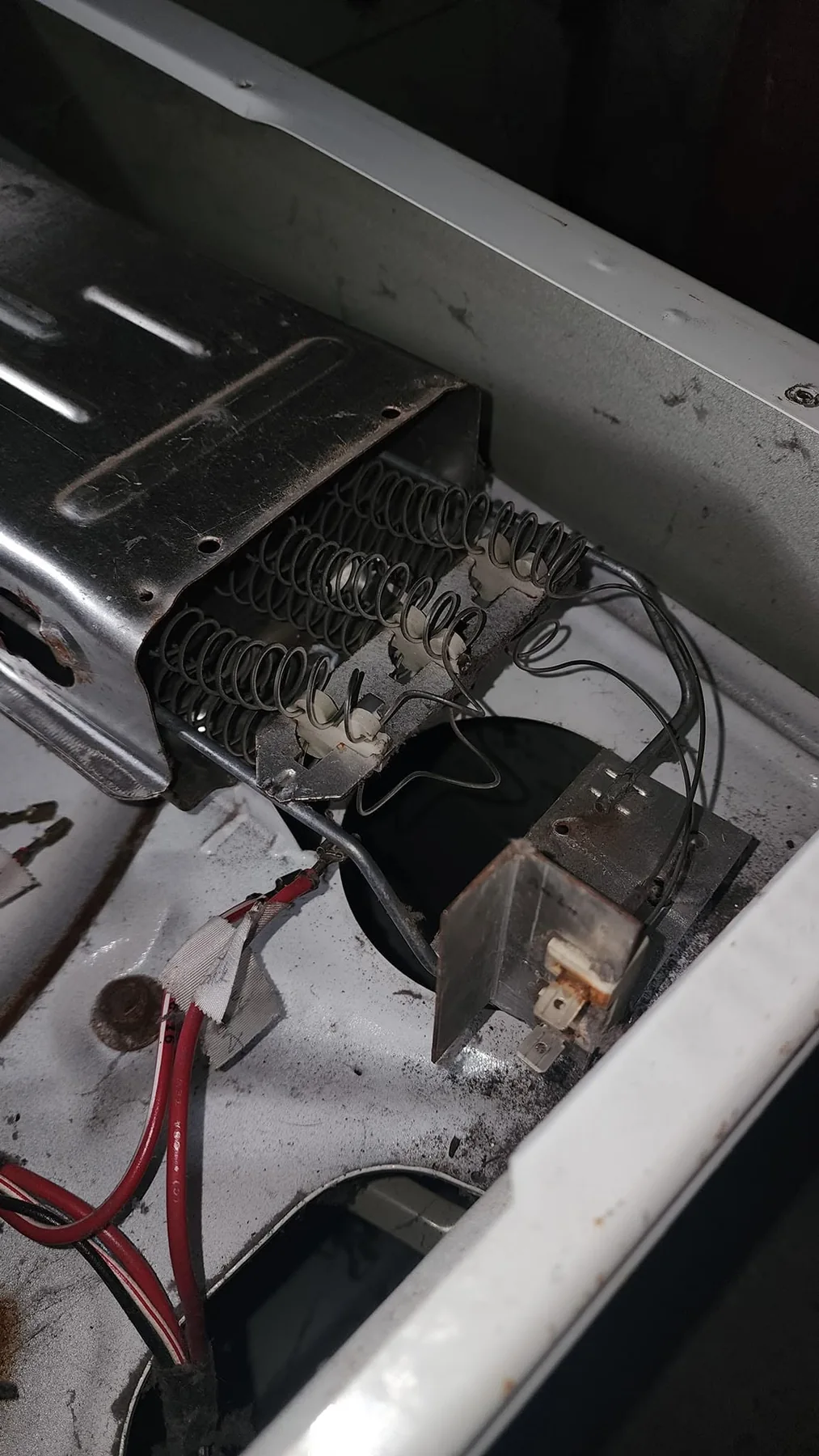
When an appliance runs but does not heat
Heating complaints can relate to an element, control, safety device or airflow issue, depending on the appliance. A visible component alone cannot confirm the cause.
Read about dryer heating problemsPhoto: an exposed appliance heater assembly.
What to notice before you call
A few safe observations can speed up diagnosis without opening the appliance or working around gas, high voltage or refrigerant.
 When did it start? Sudden and gradual problems can point to different diagnostic paths.
- Constant or intermittent? Note whether the problem happens every cycle or only sometimes.
- Sounds or smells? Record when clicking, grinding, squealing or burning odors occur.
- Error code? Write the code exactly as shown rather than clearing it first.
- Brand, model and age? Model information helps identify configuration and likely parts.
- Prior repair history? Previous work can be useful context for repeat or related symptoms.

Safety first
If you smell gas, see visible electrical arcing or smoke, or have an active water leak reaching outlets, wiring or powered components.
Do not open hazardous systems
Gas lines, high-voltage microwave components, sealed refrigeration systems and live electrical circuits are not DIY inspection areas. Note the symptom, isolate the hazard when it is safe to do so, and arrange qualified service.

How scheduling and diagnosis work
The goal is to identify the actual cause before repair decisions are made—not to replace parts based on a symptom alone.
Call (806) 207-2100 and tell us which appliance is having trouble and what you are noticing.
Share the appliance type, brand/model if available, symptom, error code and when the problem began.
Availability and any service-call/diagnostic fee will be confirmed when you book.
The technician confirms the symptom and performs component-level testing based on the appliance and failure pattern.
The cause, proposed repair and parts requirements are explained before repair decisions are made.
If an appropriate part is available, repair may proceed; otherwise the next step depends on parts availability and the approved repair plan.
Symptom → possible cause → next step
This table shows the kinds of systems a technician may investigate. It is a reference, not a diagnosis of your specific appliance.
| Symptom | Possible cause categories | What is typically checked | Next step |
|---|---|---|---|
| Refrigerator not cooling | Coils, evaporator fan, start relay, defrost system | Airflow, fan operation, defrost cycle, temperature readings | Refrigerator Repair |
| Washer won’t drain | Drain pump, hose, filter | Pump function, hose routing, blockages | Washing Machine Repair |
| Dryer won’t heat | Heating element, thermal fuse, gas ignition components | Element continuity, fuse status, relevant ignition system | Dryer Repair |
| Dishwasher won’t drain | Filter, sump, drain pump, check valve | Blockage and pump operation | Dishwasher Repair |
| Oven heats unevenly | Bake/broil element, temperature sensor, controls | Heating-element function and temperature sensing | Oven Repair |
| Ice maker not making ice | Inlet valve, fill tube, module, freezer temperature | Water supply, freezer temperature and module operation | Ice Maker Repair |
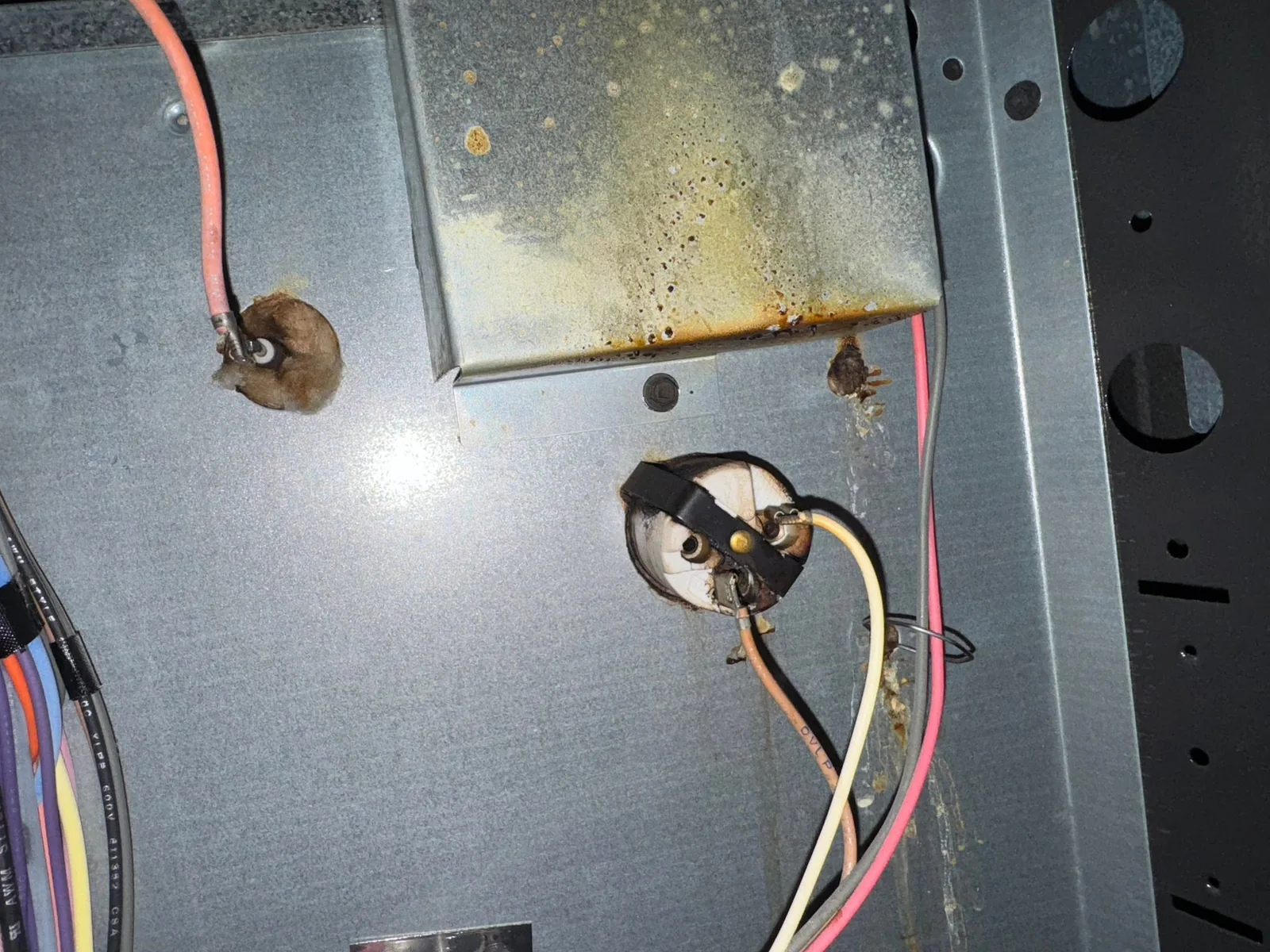
The failed part still needs to be confirmed
Wiring, thermostats and other electrical connections are among the systems a technician may inspect. The symptom-to-cause table is a starting guide—not an instruction to open or test live equipment.
Photo: appliance rear-panel components and connections.
Diagnostic concepts worth knowing
A few component names make it easier to follow what a technician explains during or after a diagnostic visit.
Thermal fuse
A one-time safety device, common in dryers, that cuts power if overheating occurs. Once tripped, it is replaced rather than reset.
Control board
The electronic controller that manages cycles, sensors and safety interlocks on many modern appliances.
Drain pump
Moves water out of washers and dishwashers; it is one system checked when an appliance will not drain.
Door / lid interlock
A safety switch that prevents operation with a door or lid open. Failure can appear as a “won’t start” symptom.
Sealed system
The refrigerator/freezer refrigerant circuit: compressor, coils and refrigerant lines. This is not a DIY system.
Igniter
A component used to light gas appliance burners. Weak or failed igniters can be one cause of “won’t ignite” symptoms.
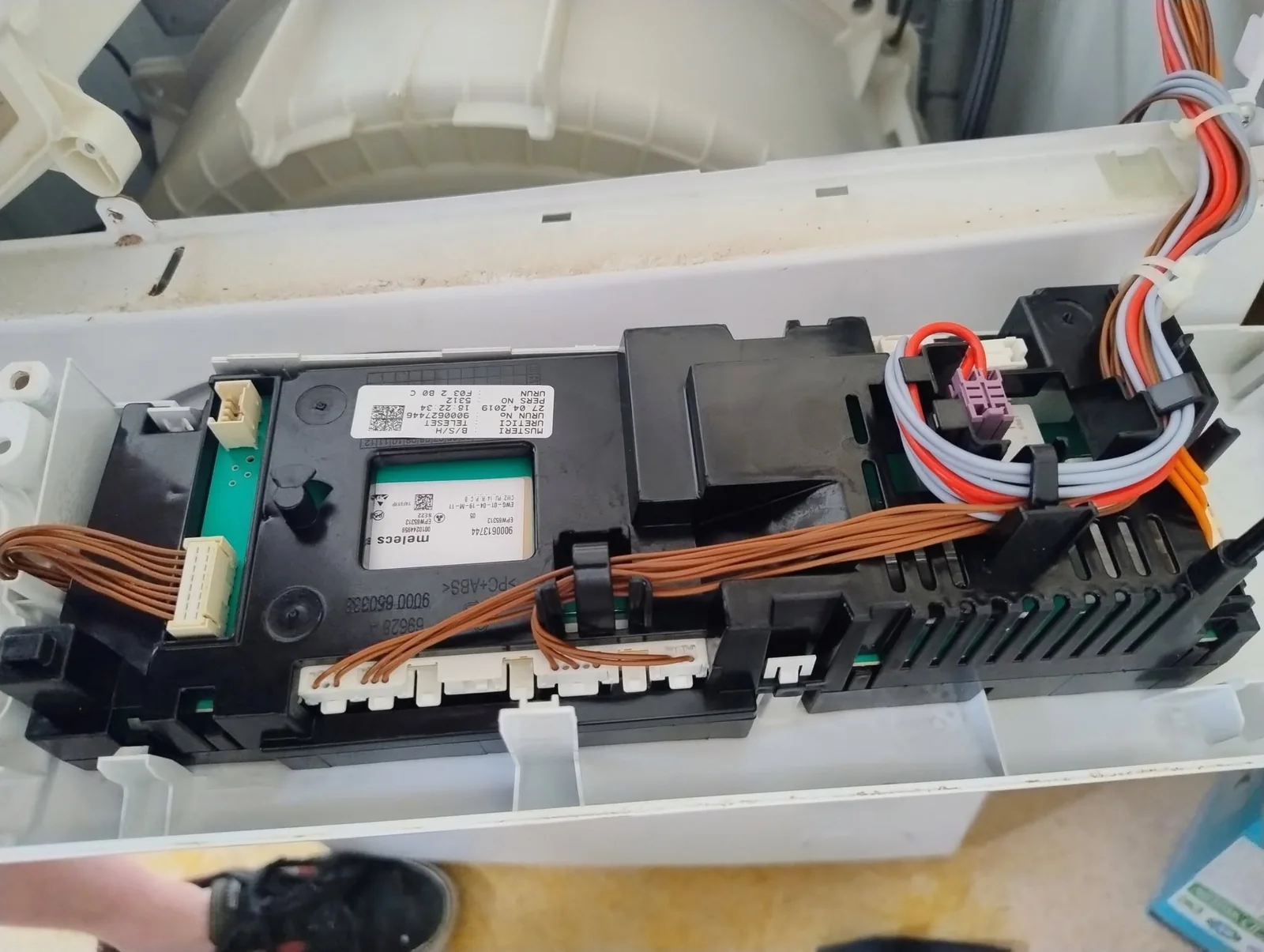
Control boards coordinate multiple appliance functions
Electronic modules receive sensor signals and help manage cycles. An error code may narrow down testing, but it does not automatically prove a control board has failed.
Find your model and serial numberPhoto: exposed appliance electronic control module.
Brands commonly seen in Lubbock homes
Major manufacturers are common across Lubbock homes and rental properties. These names are included as general appliance context—not as a claim of factory authorization or certification by Prairie Crest Appliance Repair.
Ask about your specific brand when you call.
What affects appliance repair cost?
- Appliance type and parts. A washer drain pump and a refrigerator sealed-system repair involve very different work.
- Diagnostic complexity. Some faults are quickly isolated; intermittent or multi-system issues can take more testing.
- Part availability. Common in-stock parts differ from special-order or discontinued components.
- Brand and model. Parts design and sourcing vary by manufacturer and model family.
- Installation/access. Built-in appliances and tight cabinetry can affect service access.
We don’t publish flat-rate prices — every repair is quoted after diagnosis. See Appliance Repair Cost Factors for the full decision framework.
About the diagnostic visit fee
A diagnostic/service-call fee commonly covers a technician’s time evaluating an appliance. Ask about our current policy when you call.
Ask when scheduling
Confirm whether a diagnostic/service-call fee applies before the appointment is booked.
Ask whether it is credited
If a fee exists, confirm whether any portion is credited toward approved repair work.
Do not use competitor prices
A competitor’s service-call amount is not a quote or policy for Prairie Crest Appliance Repair.
Repair or replace?
Not every appliance problem is worth repairing, and not every older appliance should automatically be replaced. Use these factors as a starting framework.
This is not a recommendation for a specific unit. See Repair or Replace an Appliance? for the full appliance-by-appliance framework.
Lubbock water, climate and housing context
These local facts explain maintenance conditions — not the cause of your specific appliance failure, which only diagnosis can determine.
| Local factor | What we know | Practical relevance |
|---|---|---|
| Water hardness | Lubbock’s municipal water supply is typically hard | Mineral scale is relevant maintenance context for dishwashers, washers, refrigerator water systems and ice makers. |
| Mineral content | Elevated mineral content is typical of the local water supply | Useful background for appliances and components that regularly contact water. |
| Water supply mix | A mix of groundwater and surface water sources | Background for why mineral characteristics can vary; it is not a component diagnosis. |
| Climate | Hot summers and low annual rainfall | Heat is useful maintenance context for cooling appliances, not a failure-rate statistic. |
| Rental / student market | Strong rental demand around Texas Tech and the surrounding area | Supports landlord, tenant and property-management repair workflows. |
Use these facts responsibly: water data explains scale and maintenance—not a failed valve or element; heat and dust are maintenance context—not proof of a failed compressor or motor; rental-market data explains workflow—not the condition of a particular property.
Where Prairie Crest Appliance Repair provides service
Primary market: Lubbock, TX and the immediately surrounding area. Select a nearby community for its dedicated local page.
 View all service areas
The full service-area page separates primary launch areas from broader surrounding coverage and explains how location relates to scheduling.
Guides and resources
Go deeper on common symptoms, repair decisions, cost factors and appointment preparation.
 Rental & multi-unit workflow
For property managers and landlords
Lubbock’s rental and student-housing market means appliance repair can be an ongoing multi-unit need. The dedicated property-manager page covers tenant coordination, documentation and scheduling considerations across properties.
Frequently asked questions
Do you offer same-day or emergency appliance repair in Lubbock?
We don’t promise same-day or emergency service. Our hours are Monday–Saturday, 8:00 AM–6:00 PM. Call (806) 207-2100 to ask about current availability
Which appliance brands do you work on?
Major household appliance brands are common across Lubbock homes. Call and ask about your specific brand — we’ll tell you whether we service it.
Do you repair appliances in rental properties or apartments?
Rental and multi-unit service is covered on the Property Managers & Landlords page. Contact Prairie Crest directly to confirm scope for your property.
How much will my appliance repair cost?
Cost depends on the appliance, the diagnosed cause, the parts involved and service access. See Appliance Repair Cost Factors; a specific repair quote should follow diagnosis.
Is there a fee just to look at my appliance?
Ask about our diagnostic fee when you schedule — we’ll confirm whether one applies before your appointment.
What areas outside Lubbock do you serve?
Primary nearby service pages include Wolfforth, Shallowater, Slaton, Idalou and Levelland. See the Service Areas page for the broader list and coverage notes.
Should I repair my appliance or replace it?
Age, repair cost relative to replacement, failure history and parts availability all matter. The Repair or Replace? guide provides the full framework.
What should I have ready when I call?
Have the appliance type, brand, approximate age, model/serial number if available, symptom, any error code and any unusual sound or smell. The appointment-preparation guide has the full checklist.
Need appliance repair in Lubbock?
Tell Prairie Crest Appliance Repair which appliance is failing, what symptom you see and, if available, the brand, model and serial number. For gas smell, visible arcing, smoke or water reaching electrical components, handle the safety issue first and stop using the appliance.
Prairie Crest Appliance Repair · 6313 Homestead Ave, Lubbock, TX 79424 · Monday–Saturday, 8:00 AM–6:00 PM